Key Takeaways
- Clean Up Your Books: Reconcile bank accounts, factoring balances, receivables, and credit lines before December 31.
- Accurately Record Year-End Revenue and Expenses: Account for unbilled December revenue, accrued wages, payroll taxes, bonuses, commissions, and PTO—even when payment occurs in January.
- Stay Ahead of Payroll and Tax Compliance: Reconcile Forms 941 with W-2/W-3 filings, verify worker classifications and W-9s, and prepare for the new 2026 overtime reporting requirements.
- Meet Filing Deadlines and Prepare for 2027: Submit required tax forms by February 1, 2027, update payroll tax rates and wage bases, and review financial statements for the year ahead.

A year-end accounting checklist for a staffing agency covers four jobs: clean up the ledger before December 31, accrue the payroll week that straddles the new year, reconcile every payroll tax filing to the W-2s, and meet the February 1, 2027 deadline for W-2s, 1099-NECs, and Form 941.
Most year-end checklists are written for companies that run payroll twice a month for a stable headcount. A staffing firm runs weekly payroll for a workforce that turns over constantly, bills clients on time-and-attendance cycles that rarely line up with the calendar, and often finances receivables through a factor or lender. That is why a year-end accounting checklist for a staffing agency needs its own structure. This guide covers the closing and compliance work. If you are looking for ways to reduce what the firm owes, start with our year-end tax planning strategies for staffing agencies, which need action before December 31.
Why a Year-End Accounting Checklist for a Staffing Agency Looks Different
Three features of the staffing model make the closure harder than it looks.
- Revenue and payroll are tied to the same hours. Every hour a placed worker logs creates a receivable and a wage liability at the same time. If the books catch one side of that hour and miss the other, the gross margin for the year is wrong.
- The workweek ignores the calendar. December 31, 2026 falls on a Thursday. If your workweek ends on Sunday, the week ending January 3, 2027 contains four days of 2026 work that will be invoiced and paid in 2027.
- Payroll volume multiplies small errors. A mapping mistake in one pay code repeats across hundreds or thousands of W-2s. This year, that risk is higher because of a new federal overtime reporting requirement, covered below.
Before December 31: Clean Up the Ledger
Do this work in November and early December, while there is still time to fix what you find.
Reconcile cash, factoring, and credit lines
Reconcile every bank account through the November statement. Then reconcile your factoring or asset-based lending statements to the general ledger:
- the reserve balance,
- fees charged,
- advances outstanding, and
- any recourse items charged back.
Factor statements and internal records drift apart quietly over a year. A reserve balance that does not tie is usually the first sign.
Work the receivables aging
Review every invoice over 90 days. Decide which ones are collectible, which need a reserve, and which should be written off. Clear unapplied cash and short payments, which are common when clients pay through vendor management systems that net out fees. If DSO crept up this year, our guide to billing practices that reduce DSO covers the year-round fixes.
Confirm worker classification and W-9s
Before January, confirm that every non-employee you paid has a valid Form W-9 on file. Chasing tax IDs in late January is how firms miss the 1099 deadline.
One threshold has changed. For payments made in 2026, the Form 1099-NEC reporting threshold is $2,000, up from $600, under the One Big Beautiful Bill Act. The threshold applies by payment date and is indexed for inflation starting in 2027. Keep tracking every payment anyway, because a contractor expected to stay small can cross $2,000 by year-end.
If any relationships sit in a gray area, revisit your W-2 vs. 1099 classification before the forms go out. Correcting a classification after the forms are filed is far more expensive.
The Cut-Off Week: Accrue What You Earned and What You Owe
This is where staffing financial statements most often go wrong.
Accrue unbilled revenue
Revenue belongs in the year the work was performed. Using the example above, hours worked December 28 through 31, 2026 are 2026 revenue even though the invoice goes out in January. Pull those hours from approved timecards, not estimates, and book an unbilled receivable. For revenue streams such as payrolling arrangements, direct-hire fees, or conversion fees, confirm the recognition is consistent with how your CPA has evaluated principal versus agent treatment.
Accrue wages and employer payroll taxes
Book the matching wage expense for those same December days, along with the employer share of payroll taxes.
Here is the nuance owners often miss. For your financial statements, those wages are a 2026 expense. For payroll tax purposes, wages are generally taxed when paid. A paycheck dated January 8, 2027 is 2027 wages: it uses 2027 wage bases and lands on the 2027 W-2. Your books and your payroll reports will legitimately differ for that week. The reconciliation should document the difference rather than force them to match.
Accrue bonuses, commissions, and PTO
Recruiter commissions on December placements, year-end bonuses, and accrued paid time off all belong in 2026 if they were earned in 2026. Document the basis for each accrual. Tax deductibility of accrued bonuses follows specific timing rules, which is a planning question for your CPA.
Payroll and Payroll Tax Reconciliation
For a staffing firm, payroll is the largest cost and the largest compliance exposure. For a deeper treatment of the multi-state rules, see our guide to payroll tax compliance for staffing firms.
Tie the 941s to the W-3
Add up the wages, Social Security wages, Medicare wages, and federal withholding from all four quarterly Forms 941. Those totals should match the Form W-3 you will file with your W-2s. Investigate any variance now, before the forms are filed, not after an IRS or SSA mismatch notice arrives.
Reconcile state wage and unemployment reporting
Repeat the exercise for every state where you had workers. Confirm:
- state withholding ties to state W-2 totals, and
- state unemployment wages were capped at each state’s own wage base.
Workers who moved between assignments in different states are where these numbers break.
Check FUTA credit reduction exposure
Most employers pay a net federal unemployment tax rate of 0.6 percent on the first $7,000 of each worker’s wages. Employers in states that carry unpaid federal unemployment loans pay more. For 2026, the Department of Labor listed California as a potential credit reduction state. The reduction is 1.5 percent, or as much as 5.3 percent if a benefit cost rate add-on applies. That would put the cost between roughly $147 and $413 per California employee, compared with $42 elsewhere.
The final determination comes after November 10, 2026. Check the Department of Labor FUTA credit reduction page and accrue the difference. The credit reduction is applied to the whole year, so firms with large California payrolls can face a sizable fourth-quarter payment.
Get the new overtime reporting right
This is the change most likely to cause W-2 corrections this cycle. Beginning with tax year 2026, employers must report “qualified overtime compensation” separately in Box 12 of Form W-2 using code TT.
What counts. Qualified overtime is generally only the premium portion the Fair Labor Standards Act requires. If a worker earns $20 an hour and $30 for overtime, only the $10 premium counts. Overtime the FLSA does not itself require should generally stay out of code TT; confirm with your CPA before you code it. That includes premiums paid above the legal requirement, such as those set by a client contract.
Why accuracy matters. Report the full qualified amount even if the employee cannot deduct all of it. Employees generally can claim the federal overtime deduction only for what appears in code TT, and correcting an error requires a Form W-2c.
What to do now. Ask your payroll provider whether code TT populates automatically from your existing overtime pay codes, and test it against a sample of December payroll. The IRS explains the rules in IRS Fact Sheet FS-2026-13 on qualified overtime. If you place workers in hospitality roles where cash tips are reported to you, note that the 2026 W-2 also adds code TP for tips.
Prepare for the workers’ compensation audit
Workers’ comp premiums are estimated up front and trued up after the policy year based on actual payroll by class code. Staffing firms place workers across many class codes, so misclassified payroll can produce a large audit bill. Run year-end payroll by class code and compare it with the policy estimates. Then accrue any expected additional premium or refund.
Year-End Accounting Checklist: Staffing Agency Filing Deadlines for Tax Year 2026
Because January 31, 2027 falls on a Sunday, the usual January 31 deadlines move to Monday, February 1, 2027. Confirm each date against the IRS General Instructions for Forms W-2 and W-3 and your state agencies.
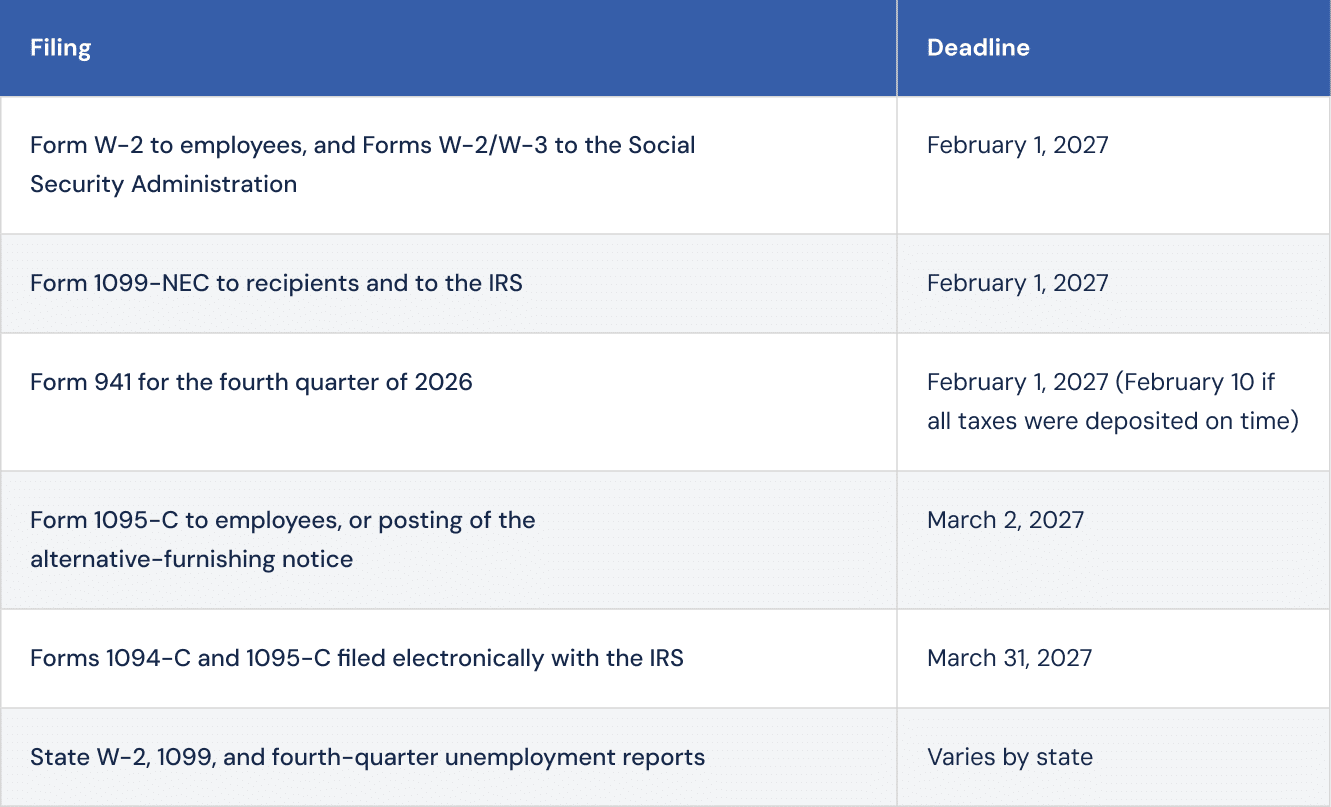
Staffing firms almost always exceed the electronic filing threshold for information returns, so plan to e-file. If your firm is an applicable large employer under the Affordable Care Act, review how variable-hour workers were measured during the year before the 1095-C data is finalized.
Set Up 2027 Before the First Payroll Runs
The close is not finished until next year’s payroll is configured correctly.
- Update the Social Security wage base. The 2027 base is $192,300, up from $184,500 in 2026. This matters for higher-paid placements such as IT and professional contractors.
- Load new state unemployment rates. Load each state’s rate notice as it arrives, along with any new state wage bases and local tax changes.
- Collect updated Forms W-4. Workers who want withholding adjusted for the overtime deduction must submit a new W-4. Payroll may not reduce withholding on its own.
- Keep screening for the Work Opportunity Tax Credit. The credit lapsed for workers who started on or after January 1, 2026, and as of mid-October 2026 Congress had not reauthorized it. State agencies are holding 2026 applications in pending status. Prior lapses were fixed retroactively, so keep filing Form 8850 within 28 days of each start date to preserve eligibility.
Close the Books: Financial Statements and the Post-Close Review
Once the accruals and reconciliations are done:
- Post adjusting entries, then review the income statement and balance sheet against the prior year.
- Explain every major variance.
- Look at gross margin by client and by branch. A firm-wide number can hide an unprofitable account.
- Prepare lender and factor reporting if your agreements require annual financial statements or covenant calculations.
- Hold a short post-close review in February or March. Note which reconciliations broke, which data arrived late, and what to change in your monthly close so next December is lighter.
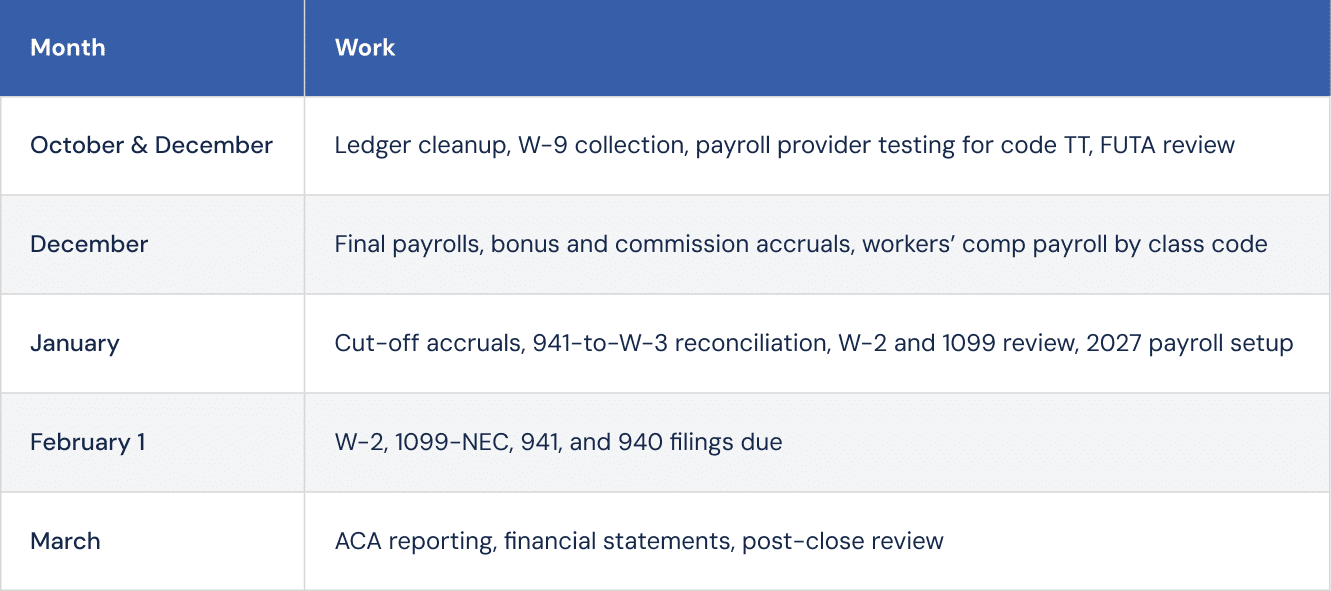
A practical cadence looks like this: