
Key Takeaways
- Slow billing is a margin tax. Staffing firms run on 18 to 30 percent gross margins. A two-week delay in average collection time on a $5M book of business can cost you $200,000 or more in financing, lost spread, and write-offs over a year.
- Most billing problems start upstream of billing. Late timecards, wrong rates, missing PO numbers, and unsigned client agreements cause 80 percent of invoice disputes. Fix the inputs and the AR aging fixes itself.
- DSO under 35 days is achievable but not by accident. It requires same-week invoicing, electronic delivery into client AP portals, a documented aging cadence, and a written collections playbook your team actually follows.
- The billing function should be staffing-specialized, not generic. Markup math, timecard reconciliation, VMS and MSP portals, and client-specific billing rules are not things a generalist bookkeeper can pick up on the fly.

If you run a staffing firm, your invoicing function isn’t an administrative cost center. It’s the throttle on your cash flow, your gross margin, and your ability to grow without bleeding working capital. You pay your contractors every Friday. Your clients pay you in 30 days, sometimes 45, sometimes 60. The gap in between is funded by your bank account or your line of credit, and every extra day in that gap costs you real money.
Most staffing owners know this intuitively. What they don’t realize is how much of the gap is self-inflicted. Late timecards, unclear bill rates, invoices submitted through the wrong channel, and AR follow-up that only happens when someone remembers: these add up to a Days Sales Outstanding number that’s 10 or 15 days higher than it needs to be. On a $5M book of business, that gap is worth six figures a year.
According to the U.S. Bureau of Labor Statistics, the temporary help services industry (NAICS 561320) employs millions of contractors across thousands of firms. The Federal Reserve Small Business Credit Survey reports that 51 percent of small employer firms cite uneven cash flows as a financial challenge, with that share even higher in industries with long client payment cycles. For staffing, that uneven cash flow isn’t a market condition. It’s a billing problem you can solve.
This guide walks through what’s actually breaking in most staffing billing operations, what a clean billing process looks like end to end, the metrics that tell you whether your billing function is healthy, and how to decide whether to keep billing in-house or hand it to a staffing-specialized team.
Why Billing for a Staffing Firm Is Its Own Discipline
Generic accounts receivable doesn’t translate to staffing. Three structural differences make staffing billing fundamentally different from invoicing in almost any other industry.
1. Billing runs off timecards, not orders
In most industries, you invoice when you ship a product or complete a deliverable. In staffing, you invoice from a contractor’s timecard, which is reported by the contractor, sometimes approved by a client manager, sometimes routed through a vendor management system (VMS) or managed service provider (MSP), and sometimes scattered across multiple client locations. If the timecard is late, wrong, or missing, the invoice is late, wrong, or missing. The timecard is the source document. Everything downstream depends on it.
2. The bill rate is not the contractor’s pay rate
Bill rate (what the client pays you per hour) is the contractor’s pay rate plus burden (payroll taxes, workers’ comp, benefits) plus markup. The markup varies by client, by assignment, sometimes by individual contractor. A firm with 200 active contractors across 30 clients can easily have 200 different bill rate configurations running at once. The invoice has to apply the right one to the right hours, every time. Get it wrong and you’re either underbilling your client (eroding margin) or overbilling them (triggering a dispute and a 30-day delay).
3. Every client has its own invoicing rules
One client wants invoices emailed to AP with the PO number in the subject line. Another requires submission through Beeline or Fieldglass. A third uses a 4-4-5 calendar and won’t accept invoices that don’t match their week-ending dates. Enterprise clients with MSP programs often require approval of the timecard inside the VMS before the invoice can even be generated. Missing any of these rules means the invoice sits in someone’s AP queue for two extra weeks while you wonder why you haven’t been paid.
The Real Cost of Slow Billing
Most staffing owners think of slow billing as a cash flow inconvenience. It’s actually a margin event. Here’s the math.
Take a $5M staffing firm running 22 percent gross margin. Average contract terms are net 30. In a perfectly run shop, DSO might run 35 days (the 30-day clock plus 5 days of invoicing and AP processing). In a poorly run shop, DSO runs 50 days. The difference, 15 days, on $5M in annual billings, is roughly $205,000 in additional receivables outstanding at any given time.
That $205,000 has to come from somewhere. Three usual sources:
- Operating cash. You’re carrying $205,000 less in your operating account than you otherwise would, which limits your ability to absorb a bad month, fund a new contract launch, or invest in recruiters.
- A line of credit. At 8 percent annual interest, $205,000 of additional draw costs about $16,400 a year in pure interest expense.
- A payroll funder. Funders charge a fee per invoice (typically 1.5 to 3 percent of the invoice value), which on $5M in factored billings translates to $75,000 to $150,000 a year. Some of that fee is irreducible, but a meaningful portion of it is tied directly to how long invoices take to get paid.
Layer on top of that, the cost of disputed invoices that get aged into write-offs, the recruiter time spent answering client AP questions instead of selling, and the management time spent on collections calls that should never have been necessary. The total cost of a slow billing function at a $5M firm is easily six figures a year. At a $25M firm, it’s seven.
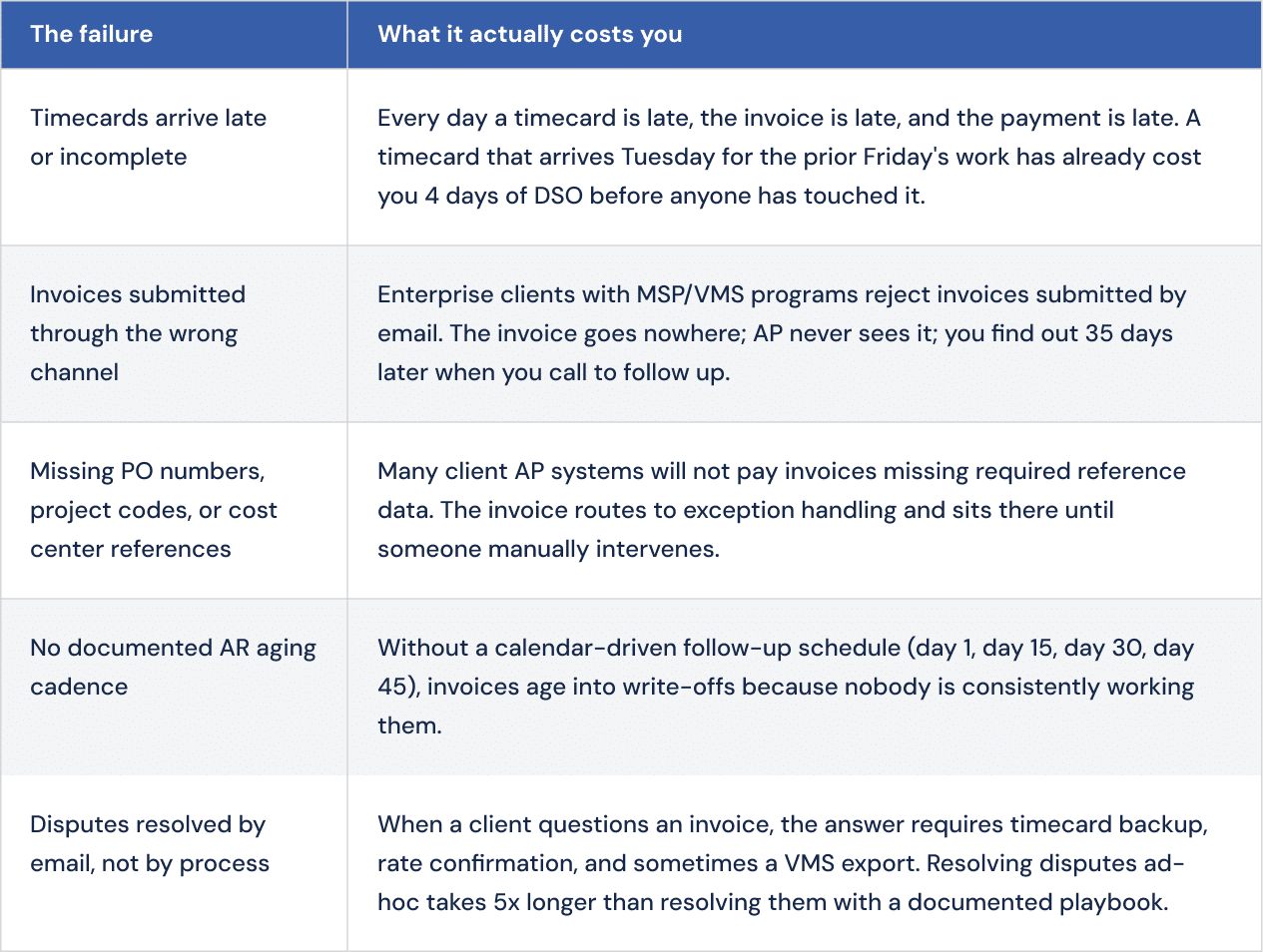
Five Billing Process Failures That Inflate DSO
Almost every staffing firm with a DSO above 45 days is suffering from some combination of these five process failures. None of them are software problems. All of them are fixable inside a quarter with the right discipline.
How to Actually Get Paid Faster: A Six-Step Playbook
Here is the operational sequence that produces a 35-day DSO at a staffing firm. None of it is exotic. It’s just consistent.
1. Timecards in by Monday noon, no exceptions
Set a hard deadline for timecard submission and approval: Monday noon for the prior week. Build the recruiter workflow around chasing missing timecards on Friday afternoon, not Monday morning. If a client manager habitually approves late, escalate it inside the client relationship before it becomes a billing problem. The single biggest lever in staffing DSO is what time the timecards land.
2. Reconcile timecards against the schedule before invoicing
Before any invoice goes out, reconcile reported hours against the assignment schedule and against any client VMS data. Catch the discrepancies internally. A discrepancy you find before invoicing takes 10 minutes to resolve. The same discrepancy after invoicing takes 30 days plus a credit memo.
3. Invoice the same week the timecard is approved
Same-week invoicing is the standard, not weekly batch on Friday for the prior two weeks. Modern staffing-specialized billing services for staffing firms can generate and submit invoices within 24 to 48 hours of timecard approval. Every extra day in the invoicing cycle is an extra day in DSO.
4. Submit through the channel the client actually uses
Maintain a client-by-client submission matrix: email AP at this address, submit to this VMS portal with this credential, follow this MSP workflow. If you don’t know how a client actually processes invoices, you don’t know how to get paid. New client onboarding should include a documented capture of every billing requirement before the first timecard is even submitted.
5. Run a documented aging cadence
Every invoice should be touched on a schedule:
- Day 0: invoice submitted, confirmation logged
- Day 15: courtesy email confirming receipt
- Day 30: follow-up call or email to the client AP contact
- Day 45: escalation to the client account manager
- Day 60: escalation inside the client (controller or AP supervisor)
- Day 90: collections decision, including potential payroll funder recourse or write-off review
Most agencies don’t have this in writing. The ones that do see DSO drop 8 to 12 days within two quarters.
6. Resolve disputes with backup, not arguments
When a client disputes an invoice, the response should be a documented timecard, a rate confirmation pulled from the client agreement, and (where applicable) a VMS export showing approval. Disputes resolved with documentation get paid. Disputes resolved with phone calls don’t.
Five Billing KPIs Every Staffing Owner Should Track Monthly
These are the metrics that tell you whether your billing function is healthy or quietly bleeding profit. A specialized accounting team will produce them every month as a matter of course. A generalist accountant typically won’t even know to ask.
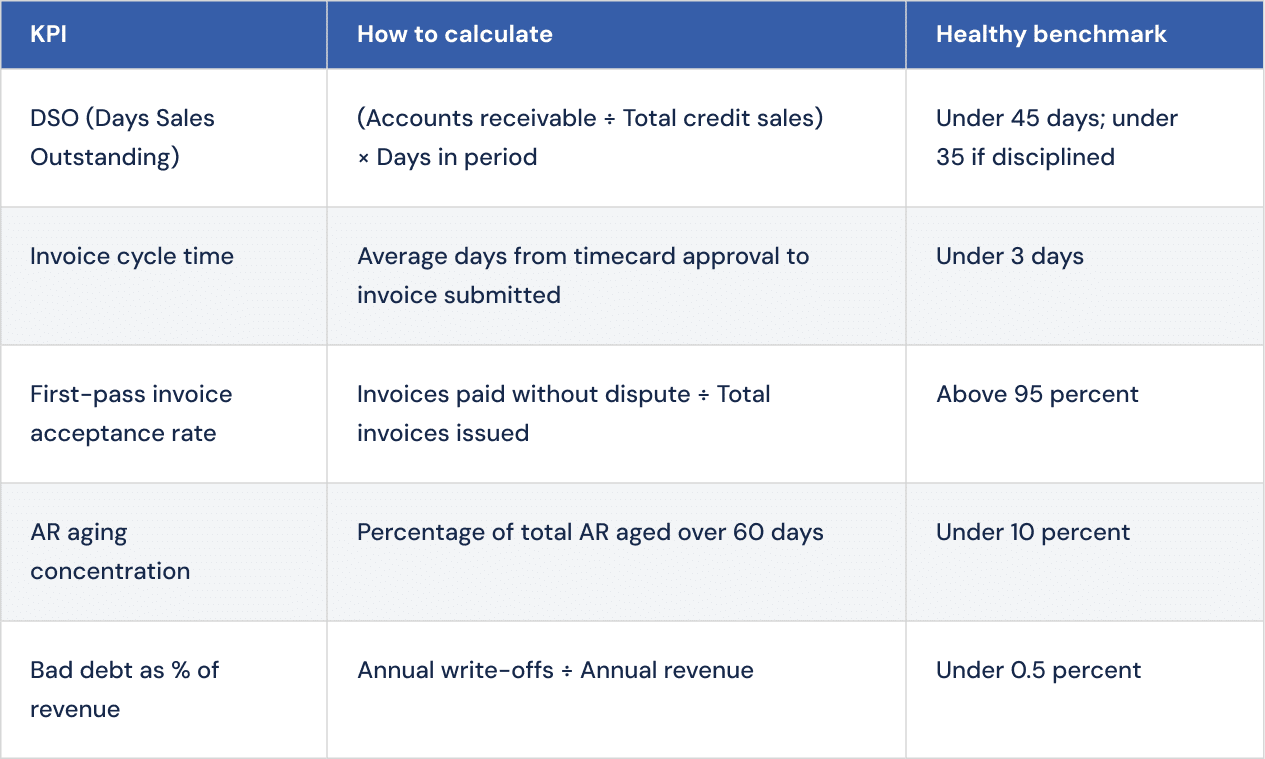
These five numbers, reviewed monthly alongside the rest of your accounting services for staffing agencies, are the difference between running your billing function by feel and running it by data. If you can’t pull them today, that itself is the answer to whether your current setup is working.
Billing Technology and the ATS-to-Back-Office Bridge
The right tools matter less than how cleanly they’re integrated. A great front office (Bullhorn, TempWorks, Avionté) feeding bad data into the back office (QuickBooks, Sage Intacct) produces invoices that are wrong, late, or both. The integration is where most agencies lose hours every week to manual reconciliation, and where most invoice errors originate.
A staffing-aware billing team should be able to:
- Map timecard data, bill rates, and pay rates cleanly between front-office and back-office systems
- Push invoices into client VMS and MSP portals (Beeline, Fieldglass, IQNavigator, etc.) without manual re-entry
- Reconcile invoice activity to GL entries so revenue recognition matches the cash that’s actually coming in
- Maintain audit trails connecting every timecard to every invoice to every payment
If your current billing setup requires anyone on your team to re-key data between systems, you’re paying for accuracy with labor and you’re still going to have errors. Re-keying is a sign the integration is broken, not that you need more headcount.
When an Invoice Becomes a Write-Off
Sometimes an invoice just isn’t going to get paid. A client goes under. An MSP relationship dissolves. A disputed amount turns into a stalemate. At that point, the question shifts from collection to tax treatment. Per IRS guidance on bad debt deductions, a business bad debt is deductible in full or in part only if the amount was previously included in gross income. Because most staffing firms operate on the accrual method (required for firms above the gross receipts threshold in IRS Publication 334), revenue from the unpaid invoice has already been booked, which means the write-off does generate a deduction when the debt becomes worthless.
The practical implications: maintain documentation of every collection effort (calls, emails, escalations), establish a written policy for when an invoice is considered worthless (typically after 120 to 180 days of failed collections), and make sure your accounting team is booking the write-off in the year it actually becomes uncollectible, not the year you finally get around to cleaning up the AR aging report. Missing the write-off year means missing the deduction.
In-House vs. Outsourced Billing: A Decision Framework
There’s no universal answer, but there is a framework most staffing owners can apply to their own firm. The deciding factor is rarely cost. It’s whether you can hire and retain people who actually understand staffing billing, because that talent is genuinely scarce.
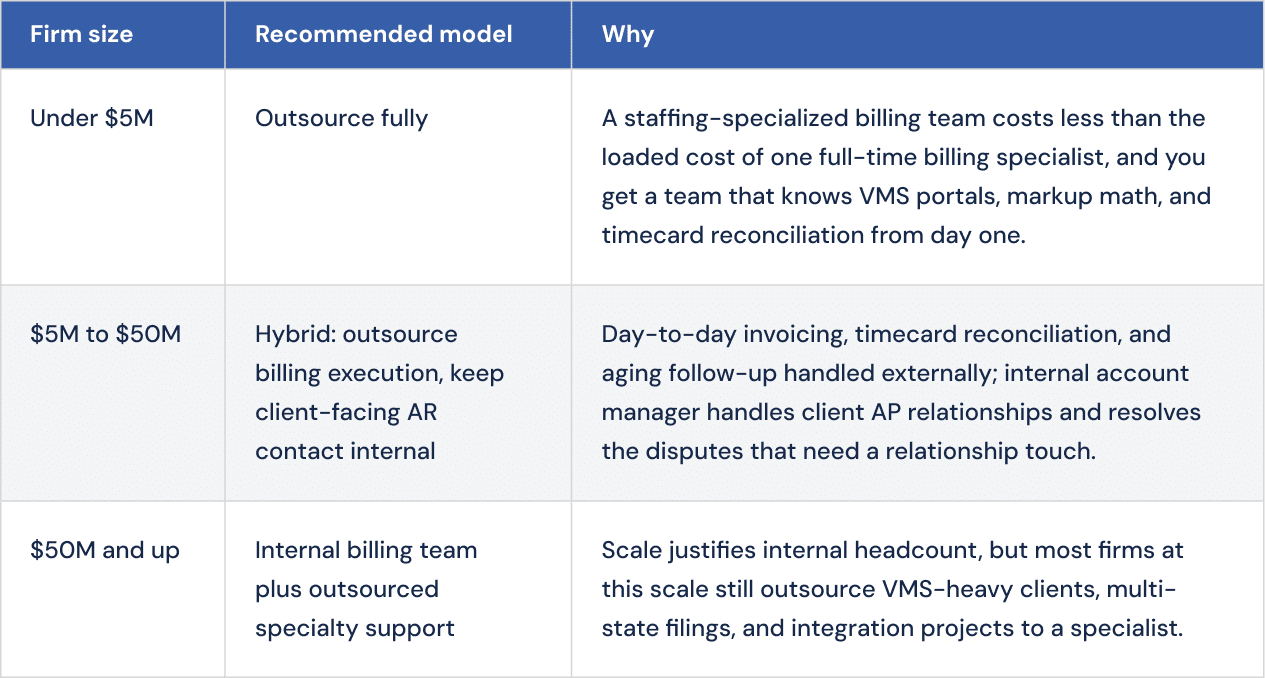
This is the band where the work RLP does has the most impact: the $5M to $50M range, where billing complexity has outgrown a single internal bookkeeper but doesn’t yet justify a full internal team. For firms thinking about pricing, margin, and growth strategy at the same time, consultative CPA services can pair with billing execution to turn cleaner data into better decisions.
Signs Your Billing Setup Is Costing You Cash
If three or more of these describe your firm, you’re already paying the cost of broken billing. You just don’t see it on a line item.
- Your DSO is above 45 days and you don’t know exactly why.
- You can’t pull a current AR aging report without someone manually rebuilding it.
- Invoices regularly go out more than 5 days after the timecard period ends.
- You’ve written off more than 0.5 percent of revenue to bad debt in the past 12 months.
- Your recruiters spend time chasing timecards or answering client AP questions.
- You’re paying a payroll funder for any reason other than deliberate strategic financing.
- Your front-office system and your accounting system don’t share data cleanly, so someone re-keys invoices every week.
- You’ve been surprised by a disputed invoice that aged 60 or 90 days before anyone caught it.
The Bottom Line
Billing in a staffing firm isn’t a back-office task. It’s the financial engine of the business. The difference between a firm that runs at a 35-day DSO and one that runs at 50 days is hundreds of thousands of dollars a year in cash, margin, and write-offs. The good news is that the gap is closeable with process, not with software, and most of the wins show up within a single quarter.
Working with an accounting team that lives in staffing every day means you don’t have to teach anyone how a markup works, why VMS portals matter, or how a 4-4-5 calendar affects invoice timing. You get timecards reconciled, invoices out the door same-week, aging worked on a documented cadence, and disputes resolved with documentation instead of phone calls.
Meet the team behind RLP or see what working with RLP looks like. When you’re ready to talk through whether we’re a fit for your billing function, talk to our team. We also handle the adjacent work: payroll for staffing firms runs off the same timecard data, so most clients use us for both.