
Key Takeaways
- Classification is a facts and circumstances test, not a choice. The IRS common law rules and the DOL’s economic reality test both look at control and economic dependence, not what you call the worker or what tax form you issue.
- Most placed staffing workers are legally employees. Because the staffing firm assigns hours, sets pay rates, and often directs the work, the vast majority of traditional temp and contract placements fail the independent contractor test regardless of paperwork.
- Misclassification exposure compounds across every worker and every year it goes uncorrected. Back FICA, FUTA, SUTA, workers’ compensation premiums, and IRS penalties can apply retroactively, and reduced-rate relief only applies if you filed 1099s consistently, not if workers were paid off the books.
- The federal rules are in flux right now. The DOL proposed rescinding the 2024 six-factor rule in February 2026 in favor of a narrower two-core-factor test, but the change is not final, so firms should classify to the stricter current standard until it is.
- There is a remediation path if you have been doing it wrong. The IRS’s Voluntary Classification Settlement Program lets you fix past misclassification prospectively for a fraction of the exposure, before an audit finds it for you.
Getting staffing agency W-2 vs 1099 workers classification wrong is one of the fastest ways for a staffing firm to turn a profitable book of business into a six or seven figure liability. The IRS and the Department of Labor both use facts and circumstances tests, not the label on the paperwork, to decide whether a placed worker is an employee or an independent contractor, and most traditional staffing placements fail the independent contractor test regardless of what the contract says. This guide walks through the tests, the real cost of getting it wrong, and how to build a defensible classification process.
Why This Question Hits Staffing Firms Harder Than Other Industries
Most businesses that misclassify a worker are dealing with one contractor. A staffing firm is making this call dozens or hundreds of times a year, across every client relationship, which means a single flawed classification policy multiplies risk across your entire book of business instead of one engagement.
The Three Worker Categories Staffing Firms Actually Deal With
Staffing firms generally place workers under one of three arrangements, and each carries a different risk profile.
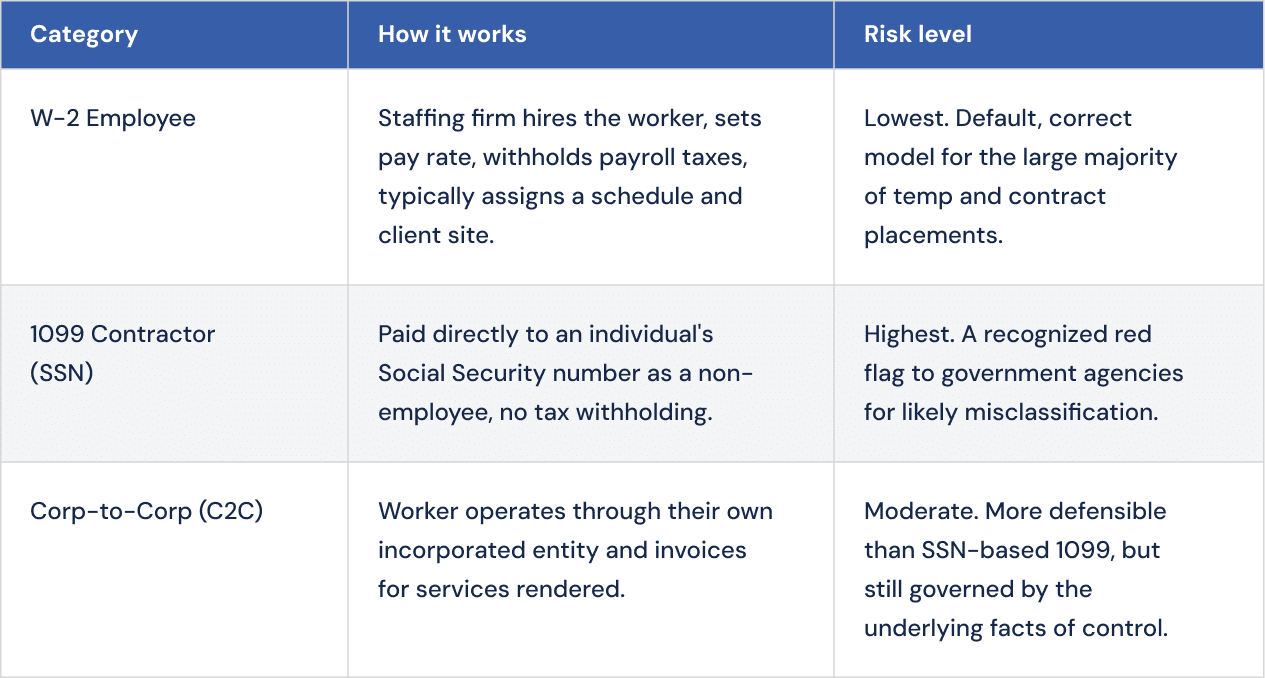
W-2 employees are hired by the staffing firm, which sets the pay rate, withholds payroll taxes, and typically assigns the worker to a client site with a defined schedule. This is the default, lowest-risk model for the overwhelming majority of temp and contract placements. 1099 independent contractors, paid to an individual’s Social Security number, are the highest-risk category; this arrangement is widely treated by government agencies as a signal of likely misclassification, since a worker paid this way rarely satisfies the independence required under either the IRS or DOL tests. Corp-to-Corp, or C2C, workers operate through their own incorporated business entity and invoice the staffing firm or client directly. This is the most defensible non-employee arrangement, but incorporation alone does not guarantee correct classification; the underlying facts, control, schedule, and integration into the client’s operations, still govern.
The Federal Tests That Decide Classification: IRS vs. DOL
Two federal agencies apply two different tests, and a staffing firm has to satisfy both.
The IRS Common Law Test
Under the IRS common law rules, classification turns on three categories of facts: behavioral control (does the business direct how, when, and where the work is done), financial control (who bears the risk of profit or loss, who provides tools and equipment), and the type of relationship (is there a written contract, are benefits provided, is the work an ongoing part of the business). No single factor is decisive. If you want a formal determination, a business or worker can file Form SS-8 and ask the IRS to rule directly on the classification.
The DOL Economic Reality Test, and Why It’s Currently in Flux
Under the Fair Labor Standards Act, the Department of Labor asks a related but distinct question: is the worker economically dependent on the business for work, or genuinely in business for themselves. The current rule, in effect since March 2024, uses six factors with no single factor controlling. On February 26, 2026, the DOL proposed rescinding that rule in favor of a narrower framework built around two core factors: the degree of control over the work, and the worker’s opportunity for profit or loss based on their own initiative. The comment period on that proposal closed April 28, 2026, and as of this writing the rule has not been finalized. Until it is, staffing firms should classify to the stricter, currently effective standard rather than assume a more permissive rule is already in place.
Staffing Agency W-2 vs 1099 Workers: The Cost of Getting It Wrong
Misclassification does not produce a single bill. It produces several, and they compound.
- Back payroll taxes. If the IRS reclassifies a worker, the staffing firm can owe the employer and employee share of FICA, plus FUTA and state unemployment tax, retroactively for every year the worker was misclassified.
- Reduced-rate relief only applies with clean paperwork. Section 3509 of the tax code allows reduced penalty rates, but only if the firm filed the required 1099s consistently. Paying a worker off the books with no information return filed removes that relief entirely.
- Direct penalties. On top of back taxes, employers can face a penalty per unfiled W-2 plus a percentage of unwithheld FICA taxes, with materially higher exposure if the misclassification is found to be willful.
- Wage and hour exposure. Under the FLSA, a reclassified worker may be entitled to unpaid overtime and minimum wage going back multiple years, along with liquidated damages in many cases.
- Workers’ compensation and unemployment claims. A misclassified worker who is injured or laid off can trigger claims the staffing firm never budgeted or insured for, often at the worst possible time.
- Liability that reaches your clients too. Under joint employer principles, a client company that receives a misclassified worker through your firm can also be pulled into liability, which is exactly the kind of exposure that ends a staffing firm’s relationship with an enterprise account.
For illustration only, not a claim about what any specific firm would owe: the IRS’s own published methodology for Section 3509(a) sets an effective reduced rate of 10.68% of wages (for compensation under the Social Security wage base) when an employer had reasonable basis and filed 1099s consistently. Applied to a hypothetical $2,000,000 in prior-year wages across a group of misclassified workers, that works out to $213,600 in reduced-rate federal liability, before state unemployment tax, before any wage and hour exposure, and before interest. Using the VCSP instead of waiting for an audit, the same firm would pay 10% of that figure, or roughly $21,360, with no interest, penalties, or audit exposure for the years being corrected. If the required 1099s were never filed at all, Section 3509(b) doubles the underlying rates, which meaningfully increases the reduced-rate figure above the reasonable-basis scenario.
The ACA Angle Most Staffing Firms Miss: Applicable Large Employer Status
Correcting a misclassification issue by moving workers onto W-2 payroll solves one problem and can quietly create another. Once a staffing firm averages 50 or more full-time employees, including full-time equivalents calculated from part-time hours, it becomes an Applicable Large Employer under the Affordable Care Act. That status triggers the employer shared responsibility provisions: the firm must offer minimum essential coverage to at least 95 percent of full-time employees or face a per-employee penalty, and file annual information returns for every full-time worker. For 2026, the penalty for failing to offer coverage runs $3,340 per full-time employee, minus the first 30, and the penalty for offering coverage that is not affordable or does not meet minimum value runs $5,010 per affected employee. A staffing firm that reclassifies a large batch of 1099 workers to W-2 status can cross the 50-FTE threshold without anyone noticing until the ACA filing deadline arrives.
Staffing Agency W-2 vs 1099 Workers: A Decision Framework
Rather than deciding classification role by role from scratch, most staffing firms benefit from a documented framework applied consistently.
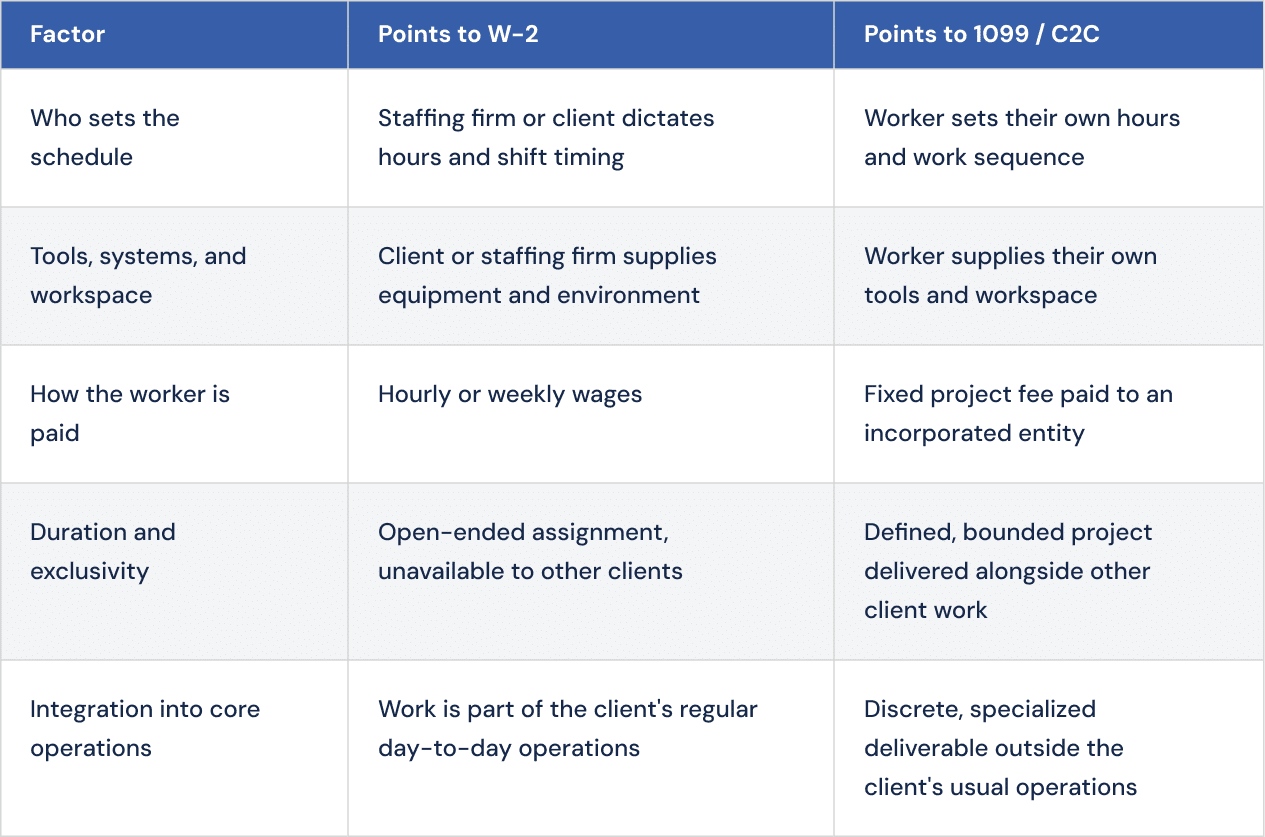
In practice, the large majority of traditional temp, temp-to-hire, and staff augmentation placements land on the W-2 side of this framework. Genuine 1099 or C2C arrangements tend to be limited to specialized, project-based engagements where the worker operates through their own business and controls how the work gets done.
If You’ve Already Misclassified Workers: What to Do Next
Finding a classification problem internally is a very different position than having the IRS or DOL find it first. The Voluntary Classification Settlement Program allows an eligible employer to reclassify workers as employees going forward and pay just over 1 percent of the prior year’s wages for those workers, with no interest, no penalties, and no employment tax audit for the years being corrected. Eligibility requires that the firm has consistently filed 1099s for the workers being reclassified and is not currently under an employment tax audit or DOL classification investigation. Separately, Section 530 relief may protect a firm going forward if it has a reasonable basis for its prior treatment and has been consistent about it, though this relief does not apply once you decide to proactively fix the classification. A staffing firm sitting on a known classification problem is almost always better off addressing it through one of these structured paths than waiting for an audit to set the terms.
Getting Classification and Payroll Right From Day One
The firms that stay out of trouble on this issue treat classification as an ongoing compliance function, not a one-time decision made at onboarding. That means documenting the classification rationale for every worker category, reviewing that documentation whenever a role or client relationship changes, tracking full-time equivalent headcount so ACA obligations do not arrive as a surprise, and running payroll through a system built for the complexity of multi-state, high-turnover staffing workforces rather than a generic small business payroll product.
This is the intersection where payroll for staffing firms and consultative CPA services actually work together. Getting the classification decision right up front, and then running clean, compliant payroll behind it, is what keeps a staffing firm’s growth from turning into deferred liability. For a broader view of how classification fits into the rest of your firm’s financial operations, our accounting services for staffing agencies and the complete guide to accounting for staffing agencies both go deeper on the surrounding back-office picture.
Meet the team behind RLP or see what working with RLP looks like. When you’re ready to have your current worker classifications reviewed, talk to our team.