
Key Takeaways
- The billing decision is a talent problem, not a cost problem. Staffing-specialized billing people (the ones who know VMS portals, markup math, and timecard reconciliation) are rare. Most owners spend months trying to hire one before realizing the search is the real cost.
- The all-in cost of internal billing is meaningfully higher than the base salary suggests. Burden, benefits, systems, coverage risk, turnover, and management time all sit outside the wage line and often go unbudgeted until they show up on the P&L.
- Outsourced billing for staffing firms is typically priced as a percentage of billed revenue or a fixed monthly fee. It usually includes full timecard-to-cash execution, day-one expertise, and no PTO or turnover risk.
- The hybrid model wins for most $5M to $50M firms. Internal person owns the client AR relationship; outsourced team handles execution. This is the structure most growing staffing firms eventually land on.

Is it possible to try and avoid calculation examples? We have already had someone question one of our posts and do not want to lose any credibility by providing incorrect numbers yet again. Unsure if I missed the sources for these statistics.
If you run a staffing firm and you’ve been going back and forth on whether to hire a billing team or outsource the function, you’ve probably framed the decision as a cost question. “How much does outsourced billing cost, and can I do it cheaper in-house?” That’s the wrong question. It’s a talent question first, and a cost question a distant second.
The people who can actually run staffing billing well (the ones who know how to reconcile a timecard against a Beeline export, apply a client-specific markup, submit through Fieldglass, and work an aging report on a documented cadence, etc.) are genuinely scarce. Most staffing billing job posts get flooded with generalist bookkeepers who can’t tell you what a 4-4-5 calendar is. The ones who can are expensive, in demand, and prone to leaving for a bigger firm the moment they’re trained.
According to the American Staffing Association, nearly 2.2 million temporary and contract employees worked for U.S. staffing companies during an average week in 2024, across an industry that hires more than 12 million workers a year. That’s a lot of timecards. The U.S. Bureau of Labor Statistics tracks the same industry (NAICS 561320) and confirms what most owners already know: the volume of transactional work in staffing is heavy, and the pool of people qualified to handle it correctly is thin.
This blog walks through what the in-house model actually requires, what outsourced billing services for staffing firms actually deliver, the real cost math, and how to decide which structure fits your firm.
The Real Question Isn’t Cost. It’s Talent.
Most owners start this analysis with a spreadsheet: “I’ll pay a billing specialist $55K plus benefits, so let’s call it $65K, and compare that to what an outsourced provider would charge.” That math is wrong before you finish typing it.
Here’s what actually goes into an internal billing hire that owners consistently miss:
- You can’t hire “a billing person.” You need a staffing-specialized billing person. A generalist bookkeeper will produce the same invoice errors your part-time office manager does today. The difference between a general AP/AR clerk and someone who can actually run staffing billing shows up in both compensation expectations and onboarding time, and you’re going to pay for that gap either way.
- The hiring cycle itself is expensive. Most staffing owners spend many months trying to fill this role. During that time, billing runs on the owner, the office manager, or a bookkeeper who’s already stretched. That’s revenue leaking through delayed invoices and missed follow-ups the entire time.
- Turnover is the ambient state. Once you train someone up on your systems, your clients’ VMS portals, and your bill rate structure, they become highly employable. The good ones tend to move to bigger firms once they’re trained. Then you start the search over.
The Federal Reserve Small Business Credit Survey reports that 51 percent of small employer firms cite uneven cash flows as an operational challenge. In staffing, the uneven cash flow usually traces back to billing. And the billing usually traces back to who’s doing it.
What “In-House Billing” Actually Requires
The word “in-house” hides the fact that you’re not just hiring one person. You’re building a small operation.
The roles
At a bare minimum, an internal billing function for a $10M staffing firm needs:
- A billing specialist to generate invoices, reconcile timecards, and manage submissions across client portals
- AR and collections coverage for aging follow-up and dispute resolution, often a partial allocation of a bookkeeper’s time or half of an FTE
- Management oversight from a controller, office manager, or the owner. Small dollar cost, real time cost, and the part owners never budget for until they’re doing it themselves at 9 PM
The systems
Internal billing means paying for and maintaining:
- Front-office integration (Bullhorn, TempWorks, Avionté) mapped cleanly to your back-office (QuickBooks, Sage Intacct)
- VMS and MSP portal access (Beeline, Fieldglass, IQNavigator) with active credentials per client
- Reporting infrastructure to pull DSO, aging concentration, and dispute rates monthly
None of these are optional. If your systems don’t talk to each other, you’re paying for accuracy with manual re-keying every week.
The management overhead
The costs owners consistently underestimate:
- Training. New hires need meaningful ramp time before they produce at full capacity, even strong ones.
- Coverage. When your billing specialist takes PTO or leaves, invoices don’t go out. That’s real DSO exposure.
- Payroll obligations. Per IRS Publication 15 (Employer’s Tax Guide), employer FICA alone is 7.65 percent of wages, and that sits on top of federal and state unemployment, workers’ comp, and benefits. All of it lands outside the base salary line, which is why the loaded cost of a hire runs meaningfully higher than the wage suggests.
- Turnover cost. Replacing a specialist carries real cost across recruiting, training, and lost productivity during the vacancy and ramp.
What “Outsourced Billing” Actually Delivers
A staffing-specialized outsourced billing provider isn’t just a virtual assistant with your login credentials. Done right, it’s a functional back office you plug into your firm.
What’s typically in scope
- Timecard collection and reconciliation across contractors, client managers, and VMS portals
- Invoice generation with client-specific bill rates, markup formulas, and required reference data
- Invoice submission through whatever channel each client requires (email, Beeline, Fieldglass, MSP portals, etc.)
- AR aging follow-up on a documented cadence (day 15, 30, 45, 60)
- Dispute resolution with documented timecard and rate backup
- Monthly reporting on DSO, first-pass acceptance, aging concentration, and other billing KPIs
- Reconciliation of billing activity to your GL
What’s usually out of scope
- Client-facing account management (the relationship layer)
- Contract negotiation and bill rate discussions
- Escalations that require a phone call from someone the client recognizes
The integration layer
The provider you want has already integrated with the front-office system you use, already has established workflows for the VMS portals your clients use, and can push clean data back into your accounting system. If you have to teach an outsourced provider how staffing works, you’ve picked the wrong one.
The same team that handles your billing can typically handle payroll for staffing firms as well, which matters because both functions run off the same timecard data. Splitting them across two providers means paying twice to reconcile the same records.
The Real Comparison
Cost is only one dimension of this decision, and it’s rarely the deciding one. The more useful comparison looks at coverage risk, expertise on day one, scalability, and how much of your leadership attention the function is going to demand. Here’s how the three models stack up:
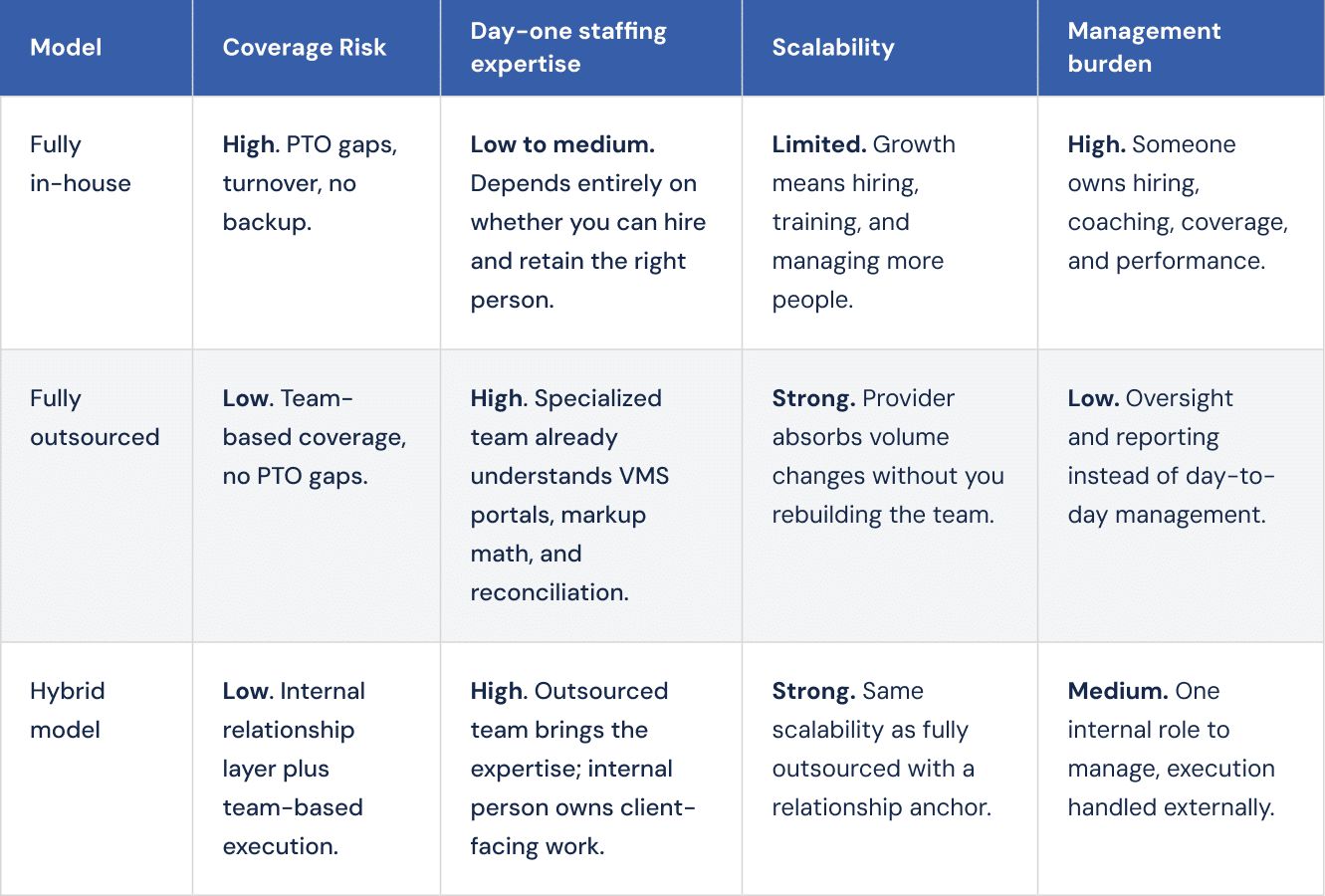
The dollars are closer than most owners expect once you account for the fully loaded cost of an internal team, which is why the decision usually comes down to the columns above rather than the price tag. An internal team, when it works, gives you tight control and someone who knows your business. When it doesn’t work, it gives you missed invoices, aging AR, and a hiring problem you can’t solve. An outsourced team gives you day-one expertise, backup coverage, and no hiring exposure. It doesn’t give you someone who sits down the hall.
When In-House Billing Wins
Internal billing is the right answer when the majority of these are true:
- You’re at $50M or more in revenue, where scale justifies a dedicated finance team
- You have unusual or proprietary systems that no outsourced provider is set up to handle
- You have a strong internal finance leader (controller or CFO) who can hire, train, and manage the team
- Your client mix is stable enough that turnover won’t torpedo the operation
- Finance is core to your firm’s identity and you want the team in the building
If you’re not hitting most of those, “in-house” is usually shorthand for “the owner or office manager will figure it out,” and that’s the setup that quietly produces elevated DSO and write-offs no one budgeted for.
When Outsourced Billing Wins
Outsourced billing is the right answer when:
- You’re under $5M and can’t justify a full-time specialist hire
- You’re between $5M and $50M and don’t have dedicated finance leadership internally
- You’re in a growth phase and hiring bandwidth is going into recruiters, not back-office
- Your client mix is complex (multiple VMS portals, MSPs, industry verticals) and you need day-one expertise across all of them
- You’ve already tried to hire a billing specialist and struggled to find or keep one
For most growing staffing firms, this is where the math and the talent problem both point.
The Hybrid Model Most Growing Firms Land On
The split that works for most $5M to $50M staffing firms:
- Internal: One account-management or client-services person who owns the relationship with each client’s AP contact. They handle escalations that need a phone call, the disputes that need someone the client trusts, and contract renewal conversations that touch billing terms.
- External: A staffing-specialized outsourced team that handles the daily execution: timecards in, invoices out, aging worked on schedule, disputes resolved with documentation, monthly reporting produced every month.
This model works because it separates the relationship work (which benefits from being internal) from the execution work (which benefits from specialized expertise, team-based coverage, and no PTO gaps). It also lets your internal person focus on the client relationships without also being the person chasing timecards on Monday morning.
Owners who pair this billing structure with consultative CPA services tend to run the tightest firms, because they get clean execution and strategic advisory at the same time.
Red Flags in Both Directions
Signs your in-house setup isn’t working:
- Your DSO is above 45 days and nobody can explain exactly why
- Invoices go out more than 5 business days after the timecard period closes
- You’ve been hiring for a billing role for more than 90 days
- Your billing specialist has taken PTO and invoices stopped going out
- Recruiters are helping with timecard chasing or AP calls
- You can’t pull a current AR aging report without someone rebuilding it manually
Signs your outsourced provider isn’t the right one:
- Not familiar with staffing-specific processes (e.g., the 4-4-5 calendar) or billing requirements (e.g., Beeline)
- Staffing represents only a small fraction of their book
- Monthly reporting lacks meaningful metrics, or doesn’t break DSO out by client
- Disputes get escalated back to you instead of resolved with documentation
- A lack of documented collections strategy or aging cadence
- No measurable improvement within the first six months of the engagement
If any of these describe your current setup, the problem isn’t in-house versus outsourced. The problem is the specific setup you have, and it may be time to improve or replace it.
How to Transition Without Breaking Cash Flow
If you decide to move from in-house to outsourced (or from one provider to another), the transition itself is where DSO may be most vulnerable. Here’s the sequence that protects cash flow:
- Document everything first. Client submission rules, bill rate matrices, VMS credentials, open disputes, billing contacts, current AR aging. Get all of it on paper before the new team touches anything.
- Run parallel for one full billing cycle. New provider generates invoices in shadow mode; internal team still submits. Compare outputs for errors before switching over.
- Migrate open AR carefully. Aged invoices need clear ownership. The new provider takes over active follow-up on recently issued invoices, while the internal team (or the outgoing provider) works out anything already significantly aged. The exact cutoff isn’t universal and should be set based on your specific aging profile.
- Set a KPI baseline before you switch. Capture current DSO, first-pass acceptance rate, and dispute rate. These metrics provide a benchmark for measuring the new provider’s performance.
- Review monthly for the first two quarters. New relationships need active oversight. If the trend isn’t moving in the right direction, the setup may need to be evaluated.
The Bottom Line
The in-house versus outsourced billing decision isn’t really about which model is less expensive on paper. It’s about whether you have the team, processes, and leadership capacity to run the specialized function that staffing billing actually requires. For most growing staffing firms, the answer to at least one of those questions is no, and the outsourced or hybrid model should be considered by default.
Whatever you decide, do it deliberately. Running an “in-house” billing function that’s really the office manager doing invoices between calls isn’t in-house billing. It’s a slow leak. Running an outsourced provider who can’t tell your clients apart isn’t outsourced billing, it’s a transfer of the problem.
See what our staffing clients say about how the transition worked for them, or see what working with RLP looks like. When you’re ready to talk through whether outsourced billing makes sense for your firm, or how a hybrid model might work, talk to our team. In addition to billing services, we provide accounting solutions specifically for staffing companies.
The best billing model is defined by the results it delivers.