
Key Takeaways
- Generic CPAs miss the financial mechanics that define staffing. The payroll-billing cash gap, markup-driven margin, multi-state nexus, and worker classification risk are not topics a generalist learns by doing one staffing client. They have to be the firm’s entire practice.
- A specialized CPA is a strategic asset, not just a compliance vendor. They model margin by client and recruiter, advise on pricing and bill rate decisions, structure owner compensation correctly, and stress-test growth scenarios before you make them.
- The cost of getting it wrong compounds. A misclassified worker, a missed state registration, or a poorly structured S-corp election can cost six figures across multiple tax years before anyone notices.
- Specialization matters most at the $5M to $50M revenue band. Below that, complexity is manageable. Above that, you usually have an internal CFO. In between, a staffing-specialized CPA is the highest-leverage hire most owners can make.

Most staffing owners pick a CPA the same way they pick a dentist. They ask another business owner for a referral, the CPA seems competent, the fees are reasonable, and the tax returns get filed on time. For a restaurant or a software consultancy, that’s usually fine. For a staffing firm, it’s a slow leak that costs the business real money for years before anyone notices.
Staffing has financial mechanics that simply don’t show up in other industries. Weekly contractor payroll funded against 30-to-60-day client receivables. Markup math that varies by client and assignment. Worker classification risk between W-2 and 1099. Multi-state payroll tax nexus from a single contractor crossing a state line. Workers’ comp class codes that change with the work being performed. A generalist CPA can produce a tax return that technically balances and a monthly financial statement that technically reconciles. What they almost never produce is decision-useful information for the owner.
This blog is about the difference. The American Staffing Association reports that nearly 2.2 million temporary and contract employees worked for U.S. staffing companies during an average week in 2024, across an industry that hires more than 12 million workers a year. With U.S. Bureau of Labor Statistics data showing thousands of staffing firms operating across NAICS 561320, the industry is large enough that a meaningful number of CPAs claim to serve it. Far fewer actually specialize in it. This guide walks through what specialization actually means, where it shows up in real dollars, and how to tell whether your current CPA fits the job your firm needs done.
What “Specialized” Actually Means in a Staffing Context
“We work with staffing companies” gets thrown around by a lot of firms that have one or two staffing clients on a roster of 200 small businesses. That isn’t specialization. It’s coincidence.
A genuinely specialized staffing CPA firm meets three tests:
1. The practice is built around staffing, not adjacent to it
The team’s deep expertise (the people who actually do the work, not just the partner who shows up to the kickoff call) has handled staffing every week for years. They know what Bullhorn, TempWorks, and Avionté output looks like. They’ve cleaned up after at least a dozen prior generalists. They’ve sat in worker classification audits and walked out with the client intact.
2. The work product reflects staffing mechanics
Monthly financials come out on a 4-4-5 calendar if that’s how your weeks fall. Gross margin is reported at the client and assignment level, not just at the firm level. Cash flow forecasts model the payroll-billing gap explicitly. Tax planning conversations bring up worker classification and multi-state nexus before you do.
3. The advice is operational, not just compliance
A specialized CPA tells you which clients are quietly destroying your margin, which recruiters’ books are profitable, what your DSO needs to look like to avoid drawing on the line, and whether your reasonable comp is in the safe range. A generalist tells you your tax return is ready to sign.
If your current CPA fails any of these three tests, you don’t have a staffing CPA. You have a CPA who happens to have staffing clients.
Where the Specialization Gap Shows Up in Real Dollars
The cost of a generalist CPA is rarely in the fee. It’s in everything they miss. Six places where the difference compounds:
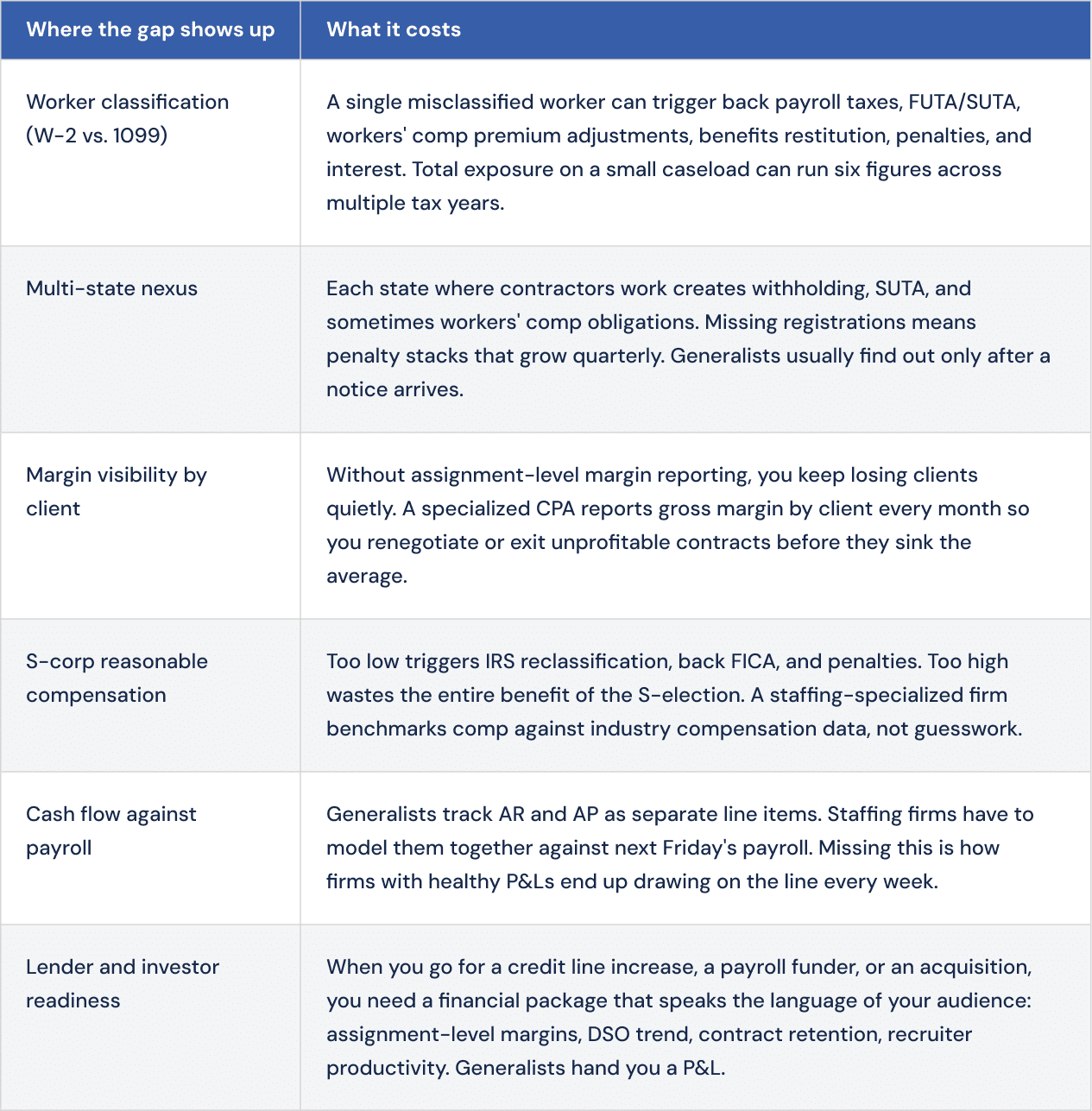
What Real CPA Consultative Services Look Like in Staffing
Consultative work is forward-looking and decision-oriented. It’s the part of the engagement that goes beyond producing financials and starts producing decisions. Consultative CPA services for staffing firms cluster into five recurring workstreams.
Margin and pricing strategy
Bill rate and markup decisions look intuitive until you measure them. Specialized advisory work involves modeling proposed bill rates against fully-loaded contractor cost (pay rate plus burden plus benefits plus overhead allocation), pressure-testing the resulting gross margin against the firm’s hurdle rate, and translating that into go/no-go decisions on individual client contracts. The same work catches the gradual margin erosion that happens when a long-time client’s bill rate hasn’t kept up with payroll tax and benefit cost increases.
Cash flow modeling against payroll cycles
In most industries, accounts receivable and accounts payable are tracked as separate concerns. In staffing, weekly payroll obligations sit against client receivables on 30-to-60 day terms, and the two have to be understood together. A specialized CPA brings that awareness into every advisory conversation: surfacing when the gap is widening, flagging the months where a new contract launch or a slow-paying client will pressure working capital, and connecting clean monthly financials to the working capital questions that matter most to a staffing owner. Detailed rolling cash forecasts and scenario modeling typically sit with an internal controller or a fractional CFO. What a specialized CPA delivers is the visibility and the right questions, so those decisions get made on real data instead of gut feel.
Entity structure and owner compensation
Most staffing firms operate as S-corporations, and the S-election is one of the highest-leverage tax planning moves available. But the IRS guidance on S-corporation officer compensation requires that distributions to a shareholder-employee be reasonable compensation for services performed; setting comp too low invites IRS reclassification of distributions as wages with FICA owed plus penalties. Specialized advisory work means benchmarking owner comp against industry data, documenting the analysis, and adjusting as the firm grows. It also means evaluating whether the S-corp is still the right vehicle as the firm scales, or whether a PTET election or different structure makes sense.
Worker classification advisory
The IRS guidance on worker classification applies a multi-factor test across behavioral control, financial control, and the relationship of the parties. Specialized advisory work applies that test on every assignment, documents the analysis, and flags exposures before they become audit findings. For most growing staffing firms, this is the single highest-impact consultative deliverable.
Growth and capital readiness
When a staffing firm wants to add a vertical, open a new geography, take on a payroll funder, expand a line of credit, or position for sale, the financial story matters as much as the operational one. Consultative work means building the financial package the audience expects: gross margin by client and vertical, DSO trend lines, contract retention metrics, recruiter productivity, and a defensible forecast. Owners who walk into a lender or buyer meeting with a generalist’s P&L lose to owners who walk in with the right package.
How Working with a Specialized CPA Changes the Day-to-Day
The difference between a generalist and a specialist isn’t most visible at year-end. It’s visible in the questions you stop having to ask, the surprises that stop happening, and the conversations that finally become productive.
Questions you stop having to answer
- “Can you explain what a markup is again?”
- “What’s the difference between bill rate and pay rate?”
- “Why do you need timecards if you have invoices?”
- “What’s a 4-4-5 calendar?”
- “Why are payroll taxes different from regular taxes?”
These are the conversations that eat hours every month when your CPA is learning the industry on your time.
Surprises that stop happening
- State payroll tax notices for states you didn’t realize you had nexus in
- Workers’ comp audit adjustments because the class codes weren’t right
- Year-end tax bills that come in three times your estimate
- Discovering at month-end that gross margin compressed and nobody flagged it
- Cash crunches the week of payroll because nobody modeled the receivables cycle
Conversations that start happening instead
- “Client X’s margin has dropped two points since you last renegotiated rates. Here’s the recommendation.”
- “Your recruiter productivity is bottom-quartile for your size. Here’s where the gap is.”
- “Your reasonable comp is below the benchmark for a firm your size. Here’s how to adjust before year-end.”
- “The new contract you’re considering will pull your DSO up two days. Here’s the financing implication.”
When Specialization Pays Off Most
The value of a staffing-specialized CPA isn’t constant across the lifecycle of a firm. It scales with complexity, and complexity scales with revenue, geography, and contract mix.
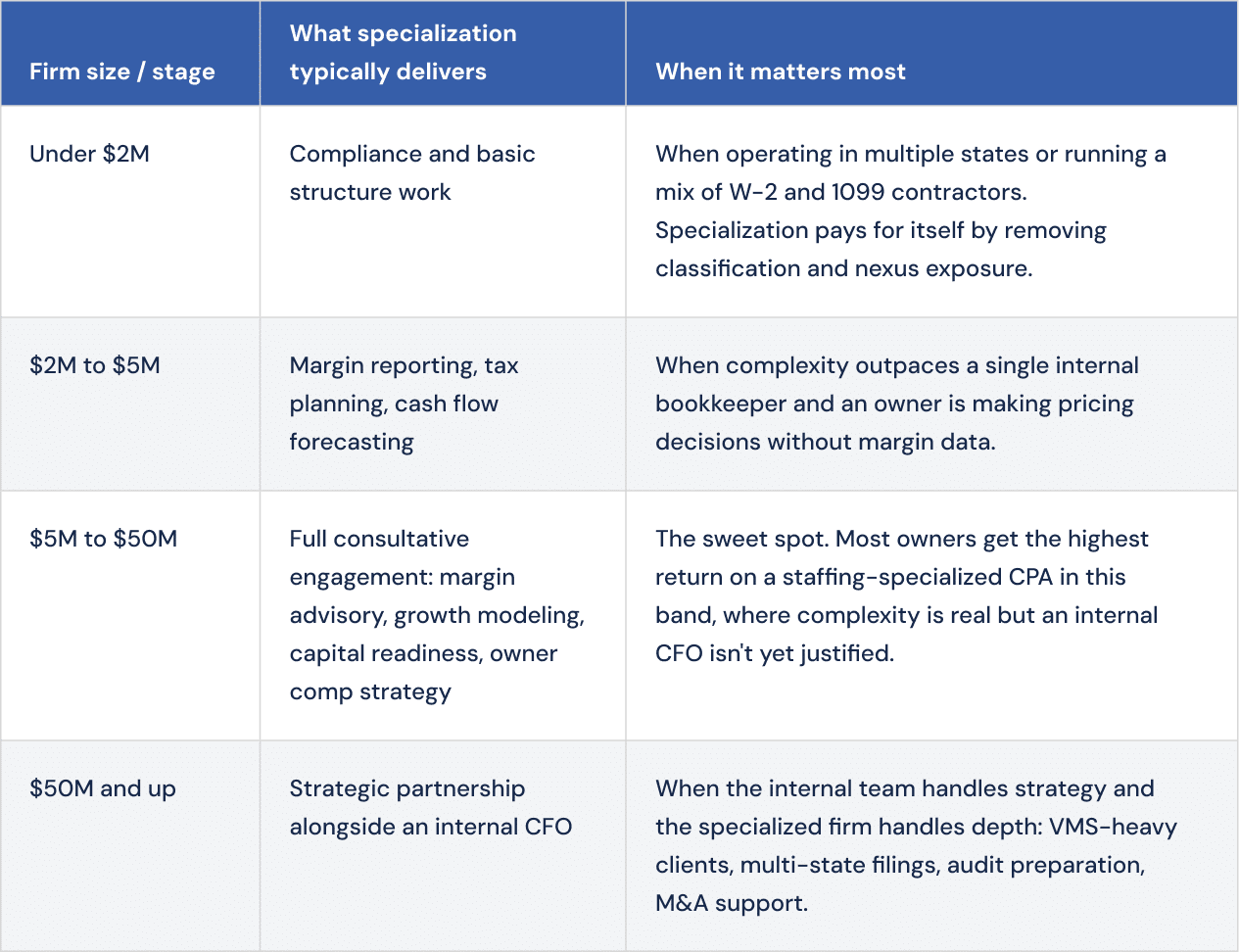
The accounting services for staffing agencies engagement RLP runs are built around the $5M to $50M band, where consultative work and execution (payroll, billing, monthly close) reinforce each other. Owners at this size who try to separate the two usually find that the consultative advice from one firm is only as good as the data quality from another, and the data quality from a generalist isn’t good enough.
Signs You’ve Outgrown Your Current CPA
If three or more of these describe your current relationship, you’re already paying the cost of generalist advice. You just don’t see it on the engagement letter.
- Your CPA asks you basic questions about how staffing works (“so the contractors are your employees, not the client’s?”).
- Your monthly financials arrive more than three weeks after month-end, and gross margin isn’t broken out.
- Tax planning conversations happen in March, not in October.
- Your CPA has never asked about your worker classification analysis or your multi-state nexus.
- You’ve been surprised by a payroll tax notice, workers’ comp audit, or year-end tax bill in the past 18 months.
- When you ask about pricing a new contract, the answer is “that’s an operational question.”
- You can’t get a current accounts receivable aging report without someone manually rebuilding it.
- You’ve considered taking on a payroll funder, a line of credit increase, or an investor, and your current financials would not survive the diligence.
The Bottom Line
Staffing is one of the financially complex industries to run, and one of the most rewarding when the back office is running well. The difference between a firm that stalls at $10M and one that scales to $50M usually isn’t the sales engine. It’s whether the financial machinery underneath the sales engine can keep up. A generalist CPA can produce a tax return. A specialist can help you build the firm.
Specialization isn’t a marketing claim. It’s measurable in the data you get, the questions you stop having to answer, the surprises that stop happening, and the strategic conversations that finally become productive. If you’ve spent years teaching your CPA how staffing works, you’ve been paying for the wrong service.
Meet the team behind RLP or see what working with RLP looks like. For owners ready for strategic finance support, consultative CPA services for staffing firms pair with our execution work in payroll for staffing firms and billing services for staffing firms to give you the full back office. When you’re ready to talk, talk to our team.